Satellite Phone

Saturday, April 23, 2011

Inmarsat Gets Ringing Endorsement for Data Capability of IsatPhone Pro

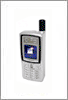
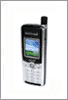
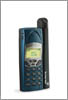
Inmarsat, the leading provider of global mobile satellite communications services, announced the availability of a range of third-party data applications for its global handheld satellite phone, IsatPhone Pro.

The recently introduced data capability of the IsatPhone Pro, which provides a circuit-switched data rate of up to an effective 20kbps on applications such as plain text email, was in response to the growing demand for basic data connectivity from mobile users equipped with a handheld satellite phone. Inmarsat’s partner network has supported the launch by introducing a range of optimised data applications for the IsatPhone Pro.

Applications from Inmarsat’s partners include: AST Onsatmail; GMPCS/Network Innovations Speedmail; MVS FlyCarrier; SatCom Global Horizon; Stratos AmosConnect; and Vizada SkyFile. A generic solution is also available from GMN Xgate. Most of these applications incorporate compression and acceleration capabilities to optimise the efficiency of the data capability of IsatPhone Pro.

Labels: , , ,

Monday, March 01, 2010

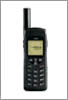
Sasken Comm to launch IsatPhone Pro - handheld satellite phone by June

Sasken Communication Technologies Ltd, a global provider of software and support services for the communication industry, has reported that IsatPhone Pro, a handheld satellite phone developed by Sasken for Inmarsat, the leader in global mobile satellite communications services, has completed its first call from Hawaii and is set for a planned global launch in June 2010, the company said in a regulatory filing.

isatphone pro

“One of the most important elements of the IsatPhone Pro development has been the R&D, and Sasken has successfully delivered on all key milestones in the last 13 months of this engagement,” said Helen Stalker, commercial director of Global Satellite Phone Services at Inmarsat. “We are all looking forward to the phone’s launch planned for June,” she added.
Sasken is responsible for end-to-end development of the IsatPhone Pro satellite phone, which has been made possible through its multi-site capabilities and centres of excellence in India, Finland and Germany. Last year around this time, we announced the partnership with Inmarsat to bring its global handheld satellite phone to the market. This year, they are all set to deliver on that promise.

Labels: , , , ,

Monday, January 19, 2009

Inmarsat warns of BGAN outages

Inmarsat has warned Asian users of its Broadband Global Area Network (BGAN) that they will lose some coverage over the next month as the operator repositions three satellites. The coverage gap for Asia will include much of China, most of southeast Asia, Western Australia, and all of Korea until the repositioning is completed tentatively by February 24.

Inmarsat coverage

The first phase of the repositioning is already underway, with the F2 satellite being relocated to better cover India and EMEA, Inmarsat's most heavily trafficked area. The repositioning move leaves a strip of the Atlantic Ocean and parts of the coasts of Africa, the UK and Greenland uncovered.

Once that phase is completed by February 7, the next phase will involve moving the F1 satellite to extend coverage in the Asia-Pacific, currently Inmarsat’s biggest BGAN customer base.

Inmarsat’s third I-4 satellite (I-4 F3), launched late last year, went into commercial service January 7, taking over BGAN traffic (including its new FleetBroadband and SwiftBroadband customers for maritime and aeronautical, respectively) from the I-4 F2 satellite. Because the first two I-4 birds were positioned to provide as much coverage as possible until the third satellite was ready, they must now be repositioned to optimize coverage over the land masses they serve and provide better look angles for the terminals.

No customer would completely lose service during the outage, and that everyone has been forewarned. Services for maritime and aeronautical customers will still be available via the I-3 satellites, although some BGAN users will have to drop down to the previous-generation GAN services. Inmarsat and distributors have been working with them, and the customer reaction has been positive because they all understand the net benefit of better service after the positioning is competed.

The customer base for services like FleetBroadband and SwiftBroadband, which leverage the I-4 satellites to enable broadband Internet services on ships and airplanes, is pretty small. Inmarsat launched those services about a year ago, and there is only about 1,500 FleetBroadband users globally. It means there’ll be very little impact for maritime users. Most of them have installed FleetBroadband gear alongside existing Inmarsat equipment. They have something naturally to fall back on. And most importantly it doesn’t impact safety services at all.

Labels: , , , , , ,

Monday, February 11, 2008

Satellite firm Avanti teams up with Inmarsat


British small cap Avanti Communications, which is trying to put its first telecommunications satellite into space, said on Friday it had teamed up with British satellite operator Inmarsat.

Avanti, which hopes to launch the HYLAS satellite in 2009, said Inmarsat would provide its existing network and satellite control centres; Inmarsat's constellation of satellites covers more than 85 percent of the globe.

Avanti was surprisingly granted the right to put a geostationary satellite into space, covering parts of Europe, India, The Middle East, Asia, Africa and the Americas, beating off other established rivals in 2006. It is building HYLAS with the European Space Agency and aims to sell its capacity to telecommunications firms.

Labels: , , ,

Wednesday, January 30, 2008

Inmarsat's I-4 fleet

This is the first of Inmarsat's 4th generation satellite fleet, was launched in March 2005 and subsequently went into service over the Indian Ocean. This fleet includes two latest generation satellites, the Inmarsat-4s (I-4s), which were launched in 2005. Together, they provide coverage to around 85 per cent of the world's landmass and 98 per cent of the world's population. That dish antenna is 9 meters across, the array of solar panels extend 45 meters. The flap at far left is a "sail", able to "harness pressure exerted by particles from the Sun - the solar wind - to steer the I-4 and fine-tune its orbital position". This bird is already improving existing Inmarsat service in its planet print, and shows its stuff in terms of high speed data.

Inmarsat is also planning to launch a third I-4 satellite in 2008. This will deliver complete mobile broadband coverage of the planet, except for the extreme polar regions. Inmarsat's first wholly owned satellites, the Inmarsat-2s, were launched in the early 1990s, and the Inmarsat-3s - the first generation to use spot beam technology - followed later in the decade.

The total fleet now comprises 10 satellites. The I-4s set a new benchmark for mobile satellite communications in terms of their power, capacity and flexibility. One I-4 satellite is 60 times more powerful than an Inmarsat-3, and the I-4 fleet is expected to have a commercial life until around 2020.

Labels: , , , ,